“Why does the same strategy print money some days and lose it on others?”
Leo asked me this two weeks into building OWL.
Our bb_bounce strategy had just crushed it — three consecutive days of profit. Then out of nowhere, five straight days of losses. Same strategy. Same parameters. Nothing changed on our end.
Leo: “It’s the same strategy. Why are the results completely different?”
Me: “Because the market changed.”
Leo: “Can’t we detect that automatically?”
And that’s how the regime system was born.
The Market’s Four Faces
A regime is basically a label for the market’s current mood. OWL classifies it into four states:
| Regime | Meaning | Characteristics | Strategies That Work |
|---|---|---|---|
| RISK_ON | Bull market | Above EMA200, MACD positive, strong trend | Trend-following (elliott, trend_momentum) |
| RISK_OFF | Bear market | Below EMA200, MACD negative, weakness | Counter-trend (contrarian, adaptive_rsi) |
| RANGING | Sideways | Low ADX, no direction, tight Bollinger | Range plays (donchian, bb_bounce) |
| CRASH | Freefall | ATR explosion, extreme FGI, sharp decline | Full exit or contrarian bets |
We originally had eight categories — BULL, BEAR, TRENDING_UP, TRENDING_DOWN, SIDEWAYS, VOLATILE… turns out eight was way too granular. The system kept flip-flopping between states. Collapsing it down to four made everything stable.
# Backward compatibility mapping
REGIME_COMPAT = {
    'BULL': 'RISK_ON', 'TRENDING_UP': 'RISK_ON',
    'BEAR': 'RISK_OFF', 'TRENDING_DOWN': 'RISK_OFF',
    'SIDEWAYS': 'RANGING', 'VOLATILE': 'CRASH',
}
Three Eyes: Rules + HMM + BOCPD
Relying on a single method to detect regimes is asking for trouble. OWL sees the market through three different eyes.
Eye 1: Rule-Based (70% weight)
Good old technical analysis:
ADX > 25 + DI+ > DI- → RISK_ON
ADX > 25 + DI- > DI+ → RISK_OFF
ADX < 20             → RANGING
ATR > 5% + FGI < 15  → CRASH
Intuitive, interpretable, easy to debug. But it has a hard limit — fixed thresholds don’t adapt when market volatility shifts.
Eye 2: HMM (30% weight)
Hidden Markov Model — probabilistic regime detection.
class RegimeHMM:
    """3-state Gaussian HMM for regime detection."""
    # Hamilton (1989) - Markov regime switching
    # Koki et al. (2022) - 2-3 regimes optimal for BTC
Feed it hourly candle returns + realized volatility, and it tells you the probability of being in each hidden state. It trains on 180 days of data (~4,320 candles) and automatically retrains every Sunday.
Here’s why HMM matters: rules say “RSI above 65 means overbought.” Period. HMM discovers natural boundaries from the data itself. In some periods RSI 60 is overbought. In others, RSI 75 is perfectly normal.
Eye 3: BOCPD (Changepoint Detection)
Bayesian Online Changepoint Detection — Adams & MacKay (2007).
If HMM tells you what regime you’re in, BOCPD tells you whether the regime is changing right now.
# BOCPD probability > 30% → changepoint warning
# 2+ consecutive triggers → regime transition review
Market’s been range-bound for days, then suddenly something shifts. BOCPD fires: “changepoint probability 45%.” This often happens before the rules or HMM even notice the transition.
Leo: “So all three have different jobs?”
Me: “Rules = assess current state. HMM = probabilistic calibration. BOCPD = detect transitions. Together they’re way more accurate than any one alone.”
Ensemble: 70% Rules + 30% HMM
ensemble_regime = rules_regime * 0.7 + hmm_regime * 0.3
# Exception: CRASH always overrides (safety first)
Why give rules 70%? Because you can explain them. When HMM says “you’re in regime 2,” it can’t tell you why. Rules can say “below EMA200 + MACD negative, so RISK_OFF.” In live trading, knowing the reason matters a lot more than you’d think.
Per-Coin Independent Regimes
This is the key insight. Just because BTC is in a bull market doesn’t mean ETH is too.
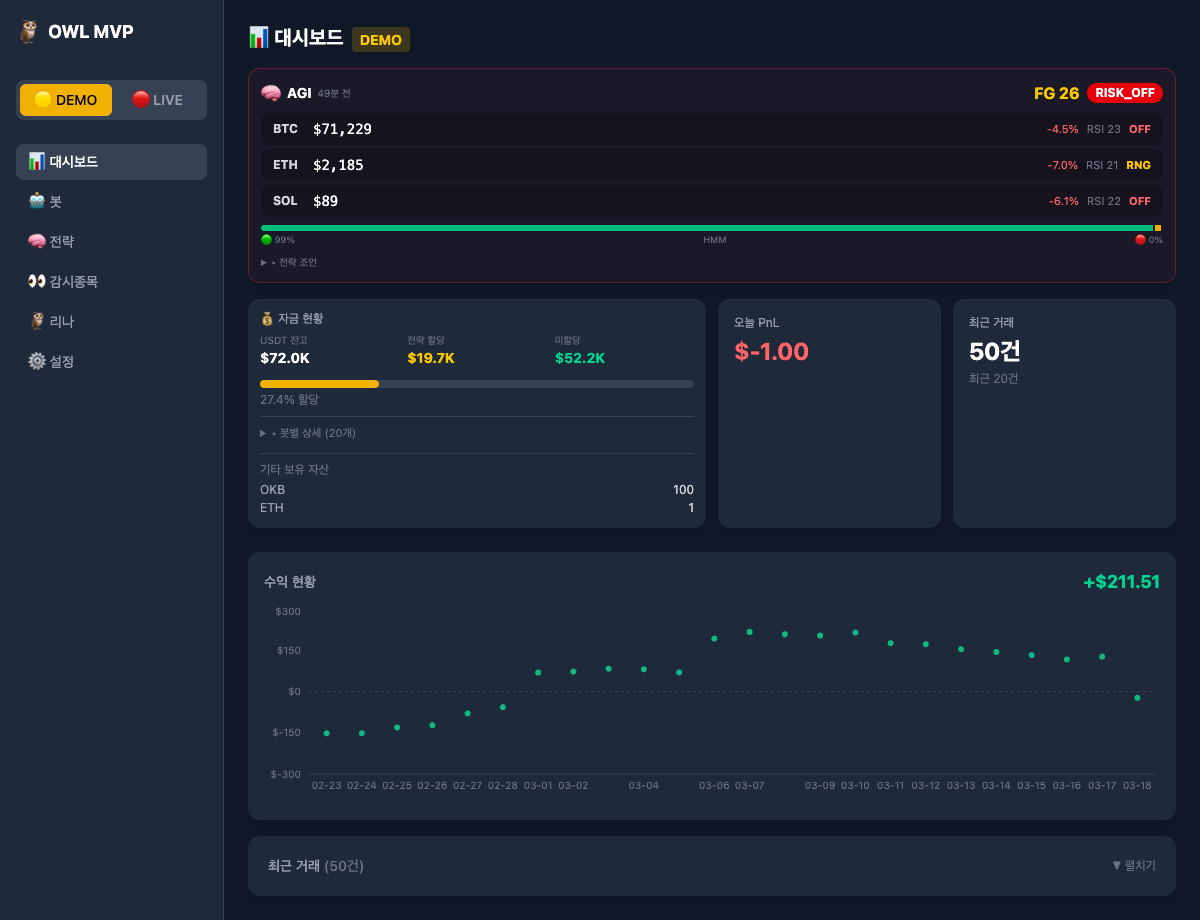 Actual dashboard. BTC: RSI 23 OFF, ETH: RSI 21 RNG, SOL: RSI 22 OFF. Same day, completely different regimes. You can see the Rules 99% + HMM bar.
"per_symbol_regime": {
    "BTC": {"regime": "RISK_OFF", "confidence": 80},
    "ETH": {"regime": "RANGING", "confidence": 70},
    "SOL": {"regime": "RISK_OFF", "confidence": 90}
}
Each Brain bot references its own coin’s regime to swap strategies. BTC Brain checks BTC regime. SOL Brain checks SOL regime. Simple as that.
Five Safety Locks: Preventing Regime Whiplash
If the regime flips constantly, strategies flip constantly, and your money evaporates into fees. So we built five layers of protection:
- 8-hour minimum hold — after a regime change, it stays for at least 8 hours
- 70% confidence threshold — only switch when you’re at least 70% sure
- 2x consecutive confirmation — one detection doesn’t trigger a switch, you need two in a row
- 2 daily transitions max — only two regime changes per day (CRASH exempt)
- Hysteresis bands — entry and exit thresholds are different
HYSTERESIS = {
    'enter_risk_on': 0.70,  # Ranging→Aggressive: need high confidence
    'exit_risk_on': 0.55,   # Aggressive→Ranging: lower bar is fine
    'enter_crash': 0.60,    # CRASH entry: fast trigger
}
Notice CRASH entry is fast (0.60) but exit is slow. We deliberately bias toward safety.
Leo: “These locks are why the Brain couldn’t switch for 6 days straight”
Me: “Yep. Too many safety nets can cause deadlock. We already covered that one.”
The FGI Fix — March 17th Surgery
On March 17th we discovered something horrifying: the regime system wasn’t using the Fear & Greed Index at all.
FGI was at 13 (extreme fear), but the rules saw “above EMA200 + MACD positive” and declared RISK_ON. Completely ignoring market sentiment. That’s like saying the weather is great while everyone around you is running for shelter.
def _apply_fgi_correction(regime, fgi):
    """Correct regime at extreme FGI values."""
    if fgi <= 10:
        return 'RISK_OFF'   # Extreme fear → force bearish
    elif fgi <= 20:
        return 'RANGING'    # Fear → downgrade to sideways
    elif fgi >= 90:
        return 'RISK_OFF'   # Extreme greed → overheating
    return regime
To prevent ping-ponging, this also requires 2 consecutive confirmations — same principle as safety lock #3.
Adaptive Thresholds: Let the Data Decide
Who decided RSI 30 means “oversold”? Some textbook from the 1980s? Different markets behave differently.
// BTC adaptive thresholds (auto-calculated from 4,299 data points)
{
    "rsi_low": 34,      // Not the standard 30 — it's 34
    "rsi_high": 65,     // Not the standard 70 — it's 65
    "atr_high": 3.75,   // BTC normal volatility ceiling
    "atr_extreme": 5.64 // Extreme volatility (CRASH trigger)
}
These get calculated automatically during HMM training. For BTC, oversold is RSI 34. For SOL, it might be RSI 28. Each coin gets its own boundaries, derived from actual data — not some universal rule that was never meant to be universal.
On-Chain Data: Signals Beyond Price
Price action is a lagging indicator. On-chain data gives you leading signals:
- Hashrate plunge → Miner capitulation = selling pressure (CRASH precursor)
- Mempool surge → Large-scale BTC movement = big move incoming
- Difficulty adjustment → Mining economics shifting
# blockchain.info free API
def fetch_btc_hashrate():
    r = requests.get('https://blockchain.info/q/hashrate')
    return float(r.text)
It’s a free API, so the data is limited. But for CRASH detection? It’s more than enough.
The Difference Regime Makes in Practice
What happens if you run bb_bounce without regime awareness?
| Period | Market State | No Regime (PnL) | With Regime (PnL) |
|---|---|---|---|
| 3/5–3/10 | RANGING | +$45 | +$45 (unchanged) |
| 3/11–3/15 | RISK_ON | -$32 | $0 (entry blocked) |
| 3/16–3/18 | RISK_OFF | -$51 | -$15 (position sized down) |
bb_bounce has 90% fitness in RANGING markets. In RISK_ON? That drops to 20%. The regime system is essentially saying, “It’s not your turn.” The strategy itself doesn’t change — the system just decides whether the current market deserves to hear from that strategy.
Current Status
As of right now (3/19):
- Global: RANGING (90% confidence)
- BTC: RISK_OFF (FGI correction)
- ETH: RISK_OFF (10% below EMA200)
- SOL: RISK_OFF (FGI correction)
FGI is at 26 — deep in fear territory. Everything’s declining, but we’re not at CRASH yet. ATR hasn’t hit extreme levels.
Lessons
-
The market isn’t one thing. The same strategy making money in a bull run and losing it in a bear market isn’t a bug — it’s the market changing face. Your strategy wasn’t wrong; it was just talking to the wrong audience.
-
Rules + Probability + Changepoint Detection = Ensemble. Any single method has blind spots. Rules are interpretable, HMM is data-driven, BOCPD catches transitions. Each covers the others’ weaknesses.
-
Per-coin regimes are non-negotiable. BTC being bullish tells you nothing about ETH. Treat them independently or pay the price.
-
Even safety nets can become the problem. Five layers of protection sounds bulletproof until they create a deadlock. Our Brain was frozen for 6 days — that’s the proof.
-
Ignoring sentiment disconnects you from reality. Technical indicators alone miss the room’s mood. When FGI is at 13 and your system says RISK_ON, something is fundamentally broken.
-
Adaptive thresholds > fixed thresholds. RSI 30 isn’t always oversold. Let the data tell you where the boundaries actually are, not a textbook written before crypto existed.
Previous post: Brain Bot — The AI That Switched Strategies and Made Zero Trades for 6 Days
Comments